

An Africa where all people can access cutting-edge cancer prevention, diagnosis and treatment.
The CancerCure Nanotechnology Lab is a research group based at the Institute for Nanotechnology Innovation at Rhodes University. Led by Professor Philani Mashazi, the Lab aims to build a globally recognised African research hub that develops innovative solutions for the lifesaving diagnosis, prevention, and treatment of cancer across Africa.
Our mission is to lead transdisciplinary research to develop Africa-focused innovative nanotechnology screening, diagnosis, and treatment for cancer, advancing minimally invasive, patient-centred care.


The Challenge
Cancer claims more lives in Africa than tuberculosis, HIV, and malaria combined, with cases predicted to double by 2040. This high mortality from cancer is driven by late-stage diagnosis, limited screening, and inadequate health infrastructure. Nanotechnology has the potential to revolutionize cancer diagnosis and treatment, offering affordable, minimally invasive diagnostic tools and treatments that have fewer side effects.
Transforming Cancer Prevention and Treatment in Africa
At the CancerCure Nanotechnology Lab we aim to address the impact of cancer in Africa through extensive, holistic research and development that incorporates nanotechnology and photosensitive drugs for screening, early detection, and effective, timely treatment.

ABOUT THE LAB
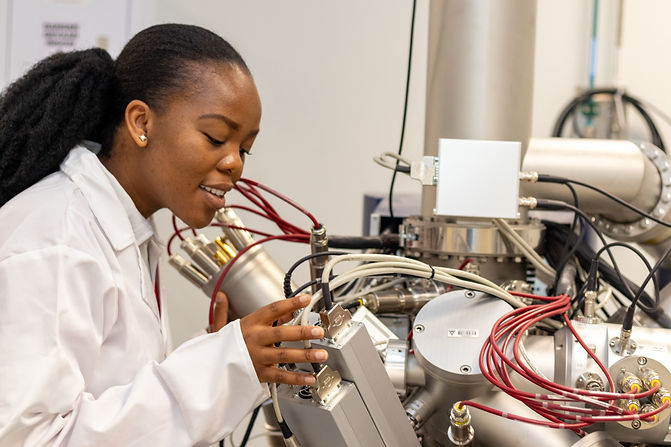
The CancerCure Nanotechnology Lab is housed within the Institute for Nanotechnology Innovation, which is nationally and internationally recognised for its research into the use of nanomaterials for cancer screening, diagnosis, and treatment.
The Institute’s broader research portfolio includes antimicrobial research to combat bacterial resistance; water treatment technologies; photovoltaic energy materials; and the developement of nanotechnology-based diagnostic systems for the ultrasensitive, early detection of disease biomarkers.
The research group currently comprises one Principal Investigator (PI), nine Master’s students, six PhD candidates, and three Postdoctoral Research Fellows.
"The future of cancer care in Africa will be shaped by science that is both world-class and deeply rooted in our continent's realities. Through cutting-edge nanotechnology, collaboration, and innovation, we are building solutions that improve lives."
— Professor Philani Nkosinathi Mashazi
Director, CancerCure Nanotechnology Lab
BUILDING THE FUTURE
Our approach to addressing the impact of cancer in Africa is to embark on extensive research and development that incorporates nanotechnology and photosensitive drugs for screening, early detection, and timely treatment.
To achieve this, we focus on three interconnected areas:
Research
Advance the understanding and application of nanotechnology for cancer screening, detection and treatment.
Strengthening capacity
Develop African nanotechnology research, human capacity, and
collaborative networks to accelerate the discovery and prototyping of cancer diagnostics and treatments.
Communication & Engagment
Advance the uptake of nanotechnology-based healthcare solutions for NGOs, healthcare providers and patients through research translation, science communication and engagement.
RESEARCH IMPACT
The CancerCure Nanotechnology Lab delivers research outputs and develops prototypes that advance nanotechnology for improved cancer prevention, diagnosis, and treatment. Our outputs include:
/01
Expanded availability of nanotechnology-based cancer diagnostics and treatments.
/02
A cancer-focused transdisciplinary consortium of nanotechnology researchers.
/03
A developed understanding of nanotechnology applications for cancer.
LEADERSHIP
Leadership in Nanotechnology and Cancer Research
As well as being Director of CancerCure Nanotechnology Lab, Professor Philani Nkosinathi Mashazi is a Professor of Chemistry and an Inaugural Director of the newly established Institute for Nanotechnology Innovation at Rhodes University. He is an NRF-C rated scientist and an award-winning scientific researcher. He currently leads the Institute in diverse, inter- and multidisciplinary research activities, seeking to address various national and international challenges related to cancer (prevention, diagnosis and treatment), antimicrobial resistance, solar energy harvesting materials, and water purification. Amongst several other roles, Prof. Mashazi is an Associate Editor for the South African Journal of Science, and a Board Member and Associate Editor of Chemistry for the Journal of Taibah University of Science.
International Collaboration and Research
Prof. Mashazi is also a Project Investigator for several international collaborative research projects sponsored by NRF SA-STINT (South Africa – Sweden Bilateral). He currently leads a multidisciplinary team of nanoscientists and nanotechnologists through the funding from Rhodes University, the Department of Science, Technology and Innovation (DSTI), and the Technology Innovation Agency Technology Platform Programme (RU-TIA Nano TPP).
Publications & Professional Memberships
Prof. Mashazi is a published author of several research articles and book chapters. He has supervised numerous postgraduate students and postdoctoral fellows. He is a National and African Representative Member of the Society of Porphyrins and Phthalocyanines (SPP). He further holds membership in IEEE Sensors, International Society of Electrochemistry (ISE), South Africa Chemical Institute - Electrochemistry and Inorganic Divisions.

"Nanotechnology is the future of more effective, patient-centered cancer prevention and treatment.”
Get in Touch
Professor Philani Nkosinathi Mashazi
Director, CancerCure Nanontechnology Lab
Rhodes University


